This page introduces the fundamental principles and protocol stages of key generation from wireless channels.
Overview
Key generation from the wireless channel has emerged as a promising technique to establish cryptographic keys for legitimate users.
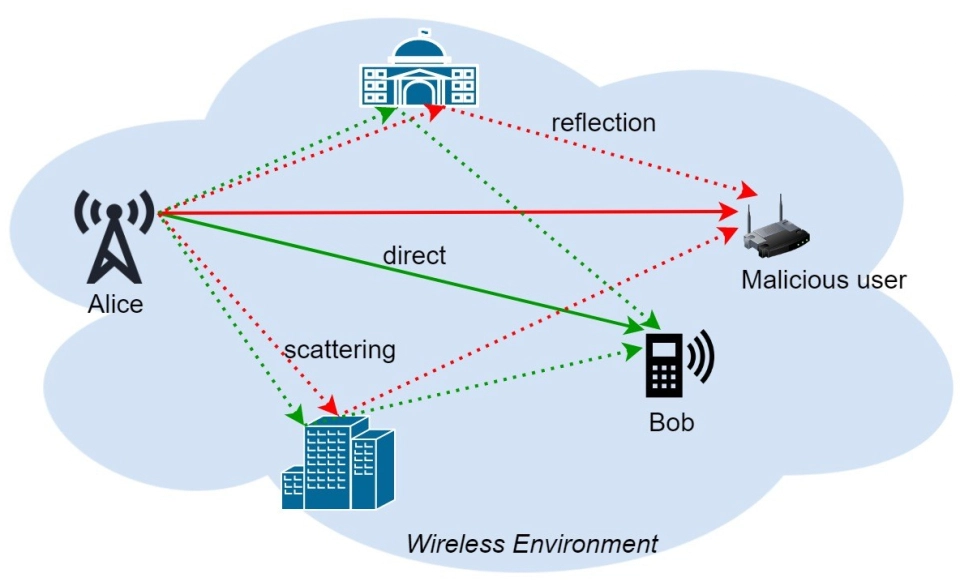
The wireless channel is intrinsic to the environment. The multipath is determined by the direct line-of-sight, reflections, and scatterings, which is affected by the layout, scatter distribution and materials, movement of users or scatterers, etc. Therefore, the features and characteristics of wireless channels are unique and unpredictable. The common randomness residing in the wireless environment between any two users can be leveraged to generate cryptographic keys for the secure communications.
Key Generation Principles
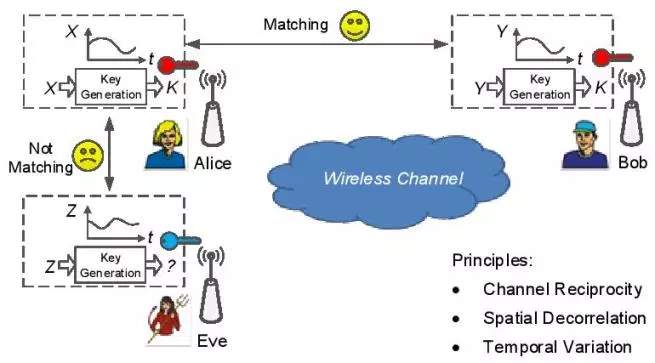
Key generation is mainly based on three principles.
- Channel reciprocity means the channel responses of the forward and backward links are the same, which is the basis for key generation. When two users measure the same channel parameters at the same frequency, the measurements will be highly correlated, which guarantees that they will generate the same key.
- Spatial decorrelation indicates that there is randomness residing in the dynamic channel, which ensures the extracted keys are random. A random key will make the cryptographic applications robust against attacks such as brute force.
- Temporal variation implies that when located a half-wavelength away from the legitimate users, the eavesdropper experiences an uncorrelated channel compared to that between Alice or Bob, guaranteeing the security of the key generation. When the system works at 2.4 GHz, a half-wavelength is about 6 cm, which is quite short.
Key Generation Protocol
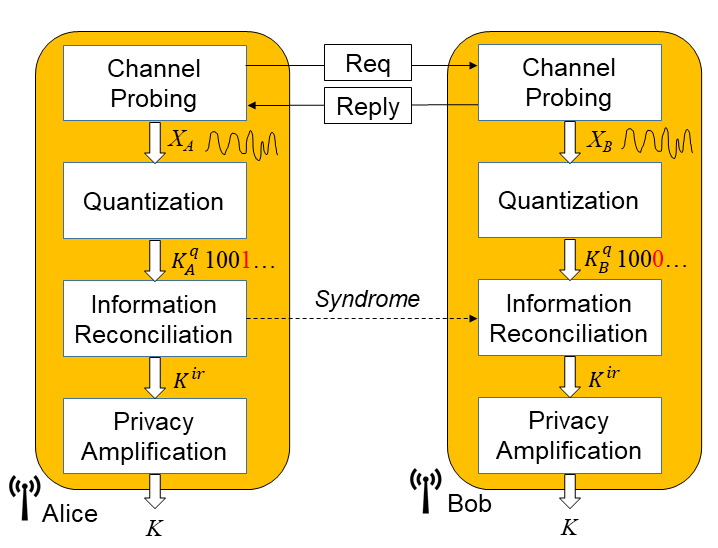
A full key generation protocol has been implemented and a demo is developed at Advanced Networks Research Group (ANRG), University of Liverpool. Please refer to the link for detailed information.
Reference
The following references provide detailed introductions and surveys.
-
2021W. Xu, J. Zhang, S. Huang, C. Luo, and W. Li, “Key generation for Internet of Things: a contemporary survey,” ACM Computing Surveys (CSUR), vol. 54, no. 1, pp. 1–37, 2021, doi: 10.1145/3429740.
@article{xu2021key, title = {Key generation for {Internet} of Things: a contemporary survey}, author = {Xu, Weitao and Zhang, Junqing and Huang, Shunqi and Luo, Chengwen and Li, Wei}, journal = {ACM Computing Surveys (CSUR)}, volume = {54}, number = {1}, pages = {1--37}, year = {2021}, doi = {10.1145/3429740}, arxiv = {2007.15956}, keywords = {keygen,survey} } -
2020J. Zhang, G. Li, A. Marshall, A. Hu, and L. Hanzo, “A new frontier for IoT security emerging from three decades of key generation relying on wireless channels,” IEEE Access, vol. 8, pp. 138406–138446, 2020, doi: 10.1109/access.2020.3012006.
@article{zhang2020new, title = {A new frontier for {IoT} security emerging from three decades of key generation relying on wireless channels}, author = {Zhang, Junqing and Li, Guyue and Marshall, Alan and Hu, Aiqun and Hanzo, Lajos}, journal = {IEEE Access}, volume = {8}, pages = {138406--138446}, year = {2020}, doi = {10.1109/access.2020.3012006}, keywords = {keygen,survey} } -
2019J. Zhang, S. Rajendran, Z. Sun, R. Woods, and L. Hanzo, “Physical layer security for the Internet of Things: Authentication and key generation,” IEEE Wireless Communications, vol. 26, no. 5, pp. 92–98, 2019, doi: 10.1109/mwc.2019.1800455.
@article{zhang2019physical, title = {Physical layer security for the {Internet} of Things: Authentication and key generation}, author = {Zhang, Junqing and Rajendran, Sekhar and Sun, Zhi and Woods, Roger and Hanzo, Lajos}, journal = {IEEE Wireless Communications}, volume = {26}, number = {5}, pages = {92--98}, year = {2019}, doi = {10.1109/mwc.2019.1800455}, keywords = {rffi,keygen,survey} } -
2019G. Li, C. Sun, J. Zhang, E. Jorswieck, B. Xiao, and A. Hu, “Physical layer key generation in 5G and beyond wireless communications: Challenges and opportunities,” Entropy, vol. 21, no. 5, p. 497, 2019, doi: 10.3390/e21050497.
@article{li2019physical, title = {Physical layer key generation in {5G} and beyond wireless communications: Challenges and opportunities}, author = {Li, Guyue and Sun, Chen and Zhang, Junqing and Jorswieck, Eduard and Xiao, Bin and Hu, Aiqun}, journal = {Entropy}, volume = {21}, number = {5}, pages = {497}, year = {2019}, doi = {10.3390/e21050497}, keywords = {keygen,survey} } -
2017J. Zhang, T. Q. Duong, R. Woods, and A. Marshall, “Securing wireless communications of the Internet of things from the physical layer, An overview,” Entropy, vol. 19, no. 8, p. 420, 2017, doi: 10.3390/e19080420.
@article{zhang2017securing, title = {Securing wireless communications of the {Internet} of things from the physical layer, An overview}, author = {Zhang, Junqing and Duong, Trung Q and Woods, Roger and Marshall, Alan}, journal = {Entropy}, volume = {19}, number = {8}, pages = {420}, year = {2017}, doi = {10.3390/e19080420}, arxiv = {1708.05124}, keywords = {keygen,survey} } -
2016J. Zhang, T. Q. Duong, A. Marshall, and R. Woods, “Key generation from wireless channels: A review,” IEEE Access, vol. 4, pp. 614–626, 2016, doi: 10.1109/access.2016.2521718.
@article{zhang2016key,
  title = {Key generation from wireless channels: A review},
  author = {Zhang, Junqing and Duong, Trung Q and Marshall, Alan and Woods, Roger},
  journal = {IEEE Access},
  volume = {4},
  pages = {614--626},
  year = {2016},
  doi = {10.1109/access.2016.2521718},
  keywords = {keygen,survey}
}